How to Approach Both Strategies – A Practical Guide
If you’ve ever applied for jobs online, you may have asked yourself a frustrating question:
Does anyone actually read these applications?
You submit your resume, tailor your cover letter, and wait. Sometimes you hear back. Often you don’t.
Then you hear someone say:
“Just get a referral. That’s the only way to get hired.”
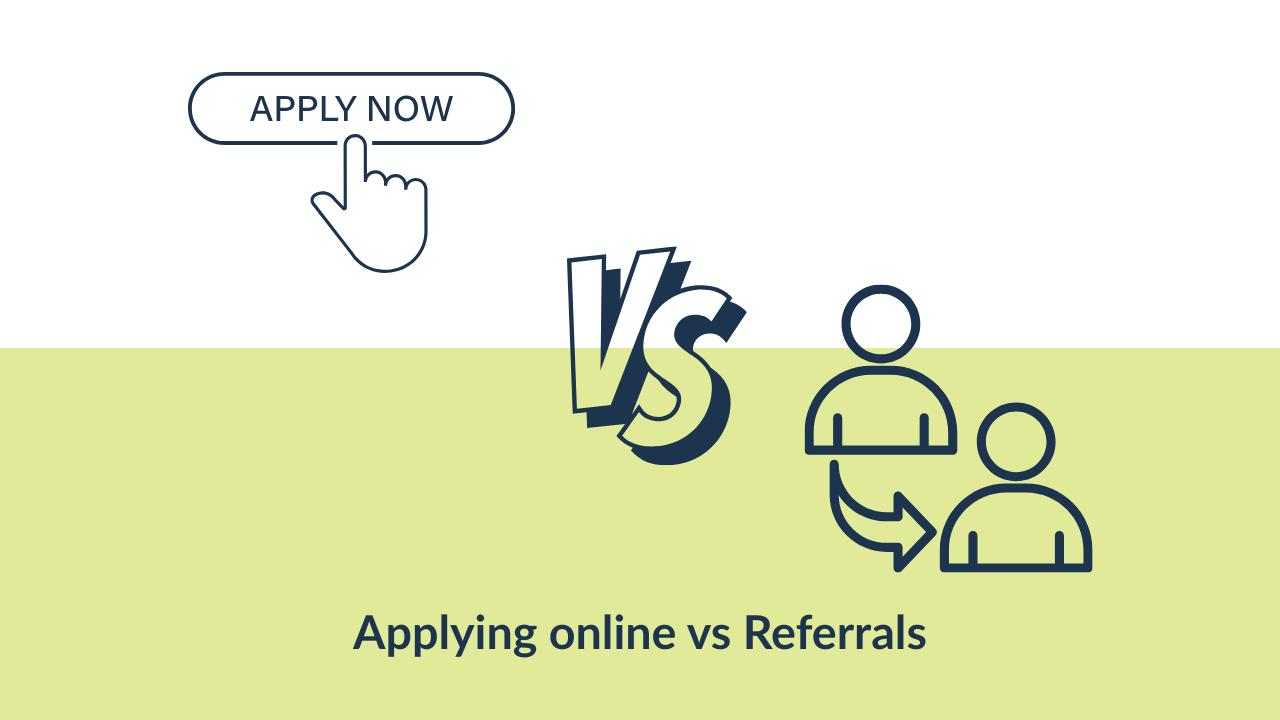
This creates confusion for many candidates. Should you spend time applying through job portals? Or should you focus entirely on networking and referrals?
The truth is that both paths can work, but they work in different ways. Understanding how companies evaluate candidates from each channel helps you approach your job search more strategically instead of relying on guesswork.
Common misconceptions
Many job seekers believe one of two extreme ideas:
- “Online applications never work.”
- “Referrals guarantee you a job.”
Neither is true.
Online applications still generate the majority of candidate pipelines for most companies. At the same time, referrals are often prioritized because they reduce hiring risk.
The challenge is that candidates rarely see how these channels are handled internally.
What people get wrong
A common mistake is treating online applications as a numbers game.
Candidates submit dozens or even hundreds of applications without adjusting their materials. This creates the feeling that the system is broken, when in reality the applications may simply lack relevance for the specific role.
On the other side, candidates sometimes misunderstand referrals. They assume that knowing someone automatically moves them to the top of the list. In reality, referrals usually guarantee visibility, not an offer.
Emotional blockers
The uncertainty of the process can lead to several mental traps:
- frustration after multiple unanswered applications
- hesitation to reach out to people for referrals
- the belief that the system is unfair or impossible to navigate
Without a clear strategy, candidates either over-apply or avoid networking altogether.
How Employers Actually Think
To understand this topic, it helps to look at how companies structure their hiring process.
Decision criteria
Recruiters and hiring managers typically evaluate candidates based on:
- relevance of experience to the role
- ability to communicate impact and achievements
- evidence of problem-solving and initiative
- potential for growth within the team
The source of the application matters less than the quality of the candidate profile.
Why referrals matter
Referrals are valuable to employers for a few reasons:
- someone inside the company is indirectly vouching for the candidate
- referred candidates often have a better understanding of the role
- referrals statistically convert to hires at higher rates
Because of this, recruiters often review referred candidates earlier in the process.
What employers don’t care about
Employers rarely care whether you found the job through:
- the company career page
- a referral
- a job board
What they care about is whether your profile clearly demonstrates fit for the role.
The UPLY Framework for This Situation
Instead of choosing between online applications and referrals, use a balanced approach.
Step 1: Start with targeted applications
Focus on roles where your experience clearly aligns with the job requirements.
Before applying:
- adjust your resume to highlight the most relevant experience
- ensure your achievements are measurable and specific
- demonstrate how your background connects to the role
A strong application dramatically increases your chances of being noticed.
Step 2: Activate your network strategically
Once you identify a role you’re interested in, check whether someone in your network works at the company.
Possible actions include:
- reaching out to alumni from your university
- connecting with employees on LinkedIn
- asking for insights about the role or team
The goal is not to demand a referral immediately, but to learn about the opportunity and build a connection.
Step 3: Combine both approaches
The most effective strategy is often:
- Apply online with a tailored application.
- Reach out to someone at the company.
- Mention that you’ve applied and are interested in learning more.
This creates both formal visibility in the system and personal visibility inside the company.
Step 4: Focus on preparation, not just access
Getting an interview through a referral only opens the door.
You still need to:
- communicate your experience clearly
- handle behavioral questions confidently
- demonstrate why you are the right candidate
Preparation is what converts opportunity into an offer.
Example (Before & After)
Before: The passive approach
A candidate:
- applies to 50 roles online
- sends the same resume every time
- waits for responses
When responses don’t come, the candidate assumes the system is broken.
After: The structured approach
The candidate changes strategy:
- targets 10 highly relevant roles
- tailors their resume to each position
- identifies employees at those companies
- reaches out for insights and potential referrals
This increases both application quality and internal visibility.
Why this works
Because hiring is not just about submitting an application.
It’s about showing clear relevance and building trust.
How to Practice This Skill
Self-practice tips
You can improve your job search strategy by practicing a few key habits:
- review job descriptions and identify the three most important requirements
- rewrite your resume summary to match the role you’re targeting
- draft short outreach messages to professionals in your field
The goal is to build a process that combines preparation and outreach.
Mistakes to avoid
Avoid these common traps:
- applying to too many roles without tailoring your resume
- asking strangers directly for referrals without context
- relying entirely on networking without submitting formal applications
A balanced approach consistently produces better results.
Practice It in a Real Simulation
Reading about job search strategies is helpful. Practicing them is what builds confidence.
UPLY allows you to simulate real career situations, refine how you present your experience, and receive AI-driven feedback before your next interview.
Because preparation shouldn’t start after you get the interview.
It should start long before.