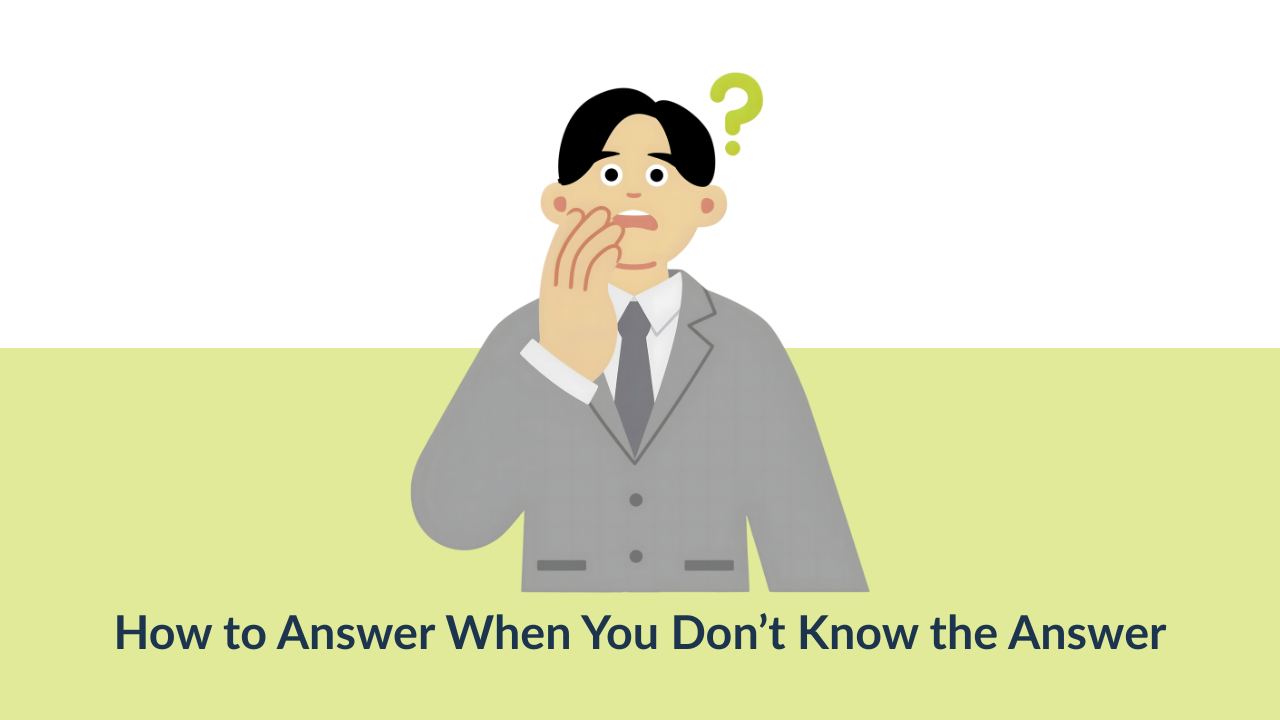
You’re in an interview or a meeting and suddenly you’re asked something you didn’t expect.
Your mind goes blank.
You think:
“I have no idea.”
In that moment, most people feel pressure to respond immediately, and to sound confident while doing it.
This situation matters more than it seems.
How you handle not knowing something often leaves a stronger impression than answering something you already know.
Because employers aren’t just evaluating your knowledge.
They’re evaluating how you think under pressure.
So the real question isn’t:
“How do I avoid not knowing?”
It’s:
“How do I respond in a way that builds trust, even when I don’t have the answer?”
Why This Is So Difficult
Not knowing something in a professional setting feels uncomfortable because it triggers:
- fear of looking incompetent
- pressure to perform instantly
- comparison to others
- the urge to “fill the silence”
Many candidates believe they’re expected to always have the right answer.
So they try to:
- guess
- over-explain
- speak in vague terms
- avoid admitting uncertainty
Ironically, these behaviors usually make things worse.
The Biggest Misconception
Many people think:
“Good candidates always have answers.”
In reality:
Strong candidates handle uncertainty well.
Employers know you won’t know everything.
What they care about is:
- how you approach unfamiliar problems
- how you communicate under pressure
- whether you stay structured and honest
Not knowing is not the problem.
Handling it poorly is.
How Employers Actually Think
When you don’t know the answer, interviewers aren’t immediately judging you negatively.
They’re observing:
- Do you stay calm?
- Do you think out loud in a structured way?
- Do you ask clarifying questions?
- Do you make reasonable assumptions?
In many roles, especially early in your career, this matters more than perfect knowledge.
Because real work often looks like:
- incomplete information
- ambiguous problems
- learning on the go
The UPLY Framework for Answering When You Don’t Know
UPLY uses a simple structure to help you respond clearly and confidently, even in uncertainty.
1️⃣ Acknowledge Honestly (Without Over-Apologizing)
You don’t need to pretend you know everything.
But how you say it matters.
Avoid:
- “I have no idea”
- “I’ve never done this at all”
Instead, say:
- “I haven’t worked with this directly yet, but…”
- “That’s a good question, here’s how I’d approach it…”
This shows honesty without shutting down the conversation.
2️⃣ Clarify the Question
Sometimes you don’t know the answer because the question is broad or unclear.
Strong candidates ask:
- “Do you mean from a technical or business perspective?”
- “Are we talking about a specific scenario?”
This buys you time and improves your answer quality.
3️⃣ Think Out Loud, Structurally
Even if you don’t know the exact answer, you can show how you think.
Structure your response:
- define the problem
- outline possible approaches
- explain your reasoning
This turns “not knowing” into a demonstration of problem-solving.
4️⃣ Connect to What You Do Know
Very rarely do you know nothing.
You can:
- reference similar experiences
- connect to related concepts
- apply general principles
This shows adaptability and learning ability.
5️⃣ Close with Learning Orientation
End your answer by showing how you would close the gap.
For example:
- “I’d validate this by…”
- “I’d check with…”
- “I’d look into…”
This reassures the interviewer that uncertainty won’t block progress.
Example (Before & After)
❌ Weak Answer
“I’m not sure… I haven’t really done that before.”
Why this fails:
- stops the conversation
- shows no thinking process
- creates uncertainty
✅ Strong Answer
“I haven’t worked on this exact situation yet, but I’d approach it by first understanding the key objective and constraints. Based on similar projects, I’d consider [X] and [Y], and then validate the approach with the team to make sure it aligns.”
Why this works:
- acknowledges the gap
- demonstrates structured thinking
- reduces perceived risk
How to Practice This Skill
This is not something you can fully learn by reading.
You need to practice:
- answering unexpected questions
- structuring thoughts under time pressure
- staying calm in uncertain situations
Try:
- mock interviews
- timed responses
- practicing out loud
- reviewing your answers
The goal is to become comfortable saying:
“I don’t fully know, but here’s how I think.”
Common Mistakes to Avoid
Pretending to know when you don’t
Over-apologizing or sounding unsure
Giving unstructured, rambling answers
Stopping after saying “I don’t know”
Confidence doesn’t come from having all the answers.
It comes from knowing how to handle it when you don’t.
Reading helps. Practicing changes outcomes.
UPLY helps you train exactly these moments, handling difficult questions, thinking under pressure, and communicating clearly through realistic simulations with AI feedback.
👉 Join the waitlist for UPLY and practice before it matters.